Buy a playhouse for a toddler and, a few years later, you'll probably catch a very different kid using it in a very different way. The wobbly explorer who once just liked opening and closing the door becomes a preschooler running an elaborate pretend bakery, then a six-year-old inventing rules for who's "allowed" inside, and eventually a nine-year-old who wants it purely as somewhere to sit with a friend, away from the adults.
Understanding how that relationship changes at each stage helps you buy smarter the first time, instead of replacing a playhouse every couple of years because it stopped fitting how your child actually plays.
What we'll cover:
- How toddlers, preschoolers, early-elementary kids, and pre-teens each use a playhouse differently
- The must-have features at each stage
- How to choose one playhouse that can realistically keep up with all of them
Toddlers (ages 1–3): sensory discovery and cause-and-effect
At this age, play is driven almost entirely by sensory exploration and basic motor skills, not storylines. A toddler is fascinated by the physical mechanics of the playhouse itself: opening and closing the door, peering through a window, stepping over the threshold, touching different textures and surfaces. Around age two, the first flickers of imaginative play tend to show up, usually as single, repeated actions rather than an actual story — "feeding" a stuffed toy, knocking on the door and waiting, putting a hat on and taking it off, again and again. Socially, toddlers are still deep in parallel play: your child might be perfectly happy playing right next to another toddler in the same space without actually playing together yet, and that's completely normal at this stage.
Playhouse must-haves for toddlers: Low, wide, easy-to-navigate doorways without a high step to trip over. Smooth, rounded edges and no small, detachable parts that could be a choking hazard. A compact footprint that suits a smaller body and shorter attention span, without empty space that feels overwhelming. Close sightlines for supervision, since this age group still needs an adult nearby at all times.
Preschoolers (ages 3–5): the golden age of pretend play
Somewhere around three, kids develop the capacity for genuine symbolic play — treating one thing as if it were another, and holding onto that pretense for extended stretches. This is when the playhouse stops being a structure to explore and becomes a stage for full pretend scenarios: running a shop, hosting a tea party, being a firefighter on a rescue mission. Socially, play shifts from parallel to associative and even early cooperative play, with kids starting to assign roles ("you be the customer, I'll be the shopkeeper") rather than just playing side by side. Physically, gross motor confidence increases a lot in this window — climbing in and out, moving quickly between the playhouse and the rest of the yard, and generally being far more capable and adventurous than they were a year earlier.
Playhouse must-haves for preschoolers: Enough interior space for two or three kids to play together, since cooperative games are starting to take off. Simple functional details — a mailbox, a serving window, a working latch — that give pretend play something concrete to work with. Durable surfaces that can handle "kitchens," chalk, and general rough-and-tumble use without showing damage after a week. Enough clearance and sturdiness to handle more energetic climbing and movement than a toddler would attempt.

Early elementary (ages 6–8): active rules and secret clubs
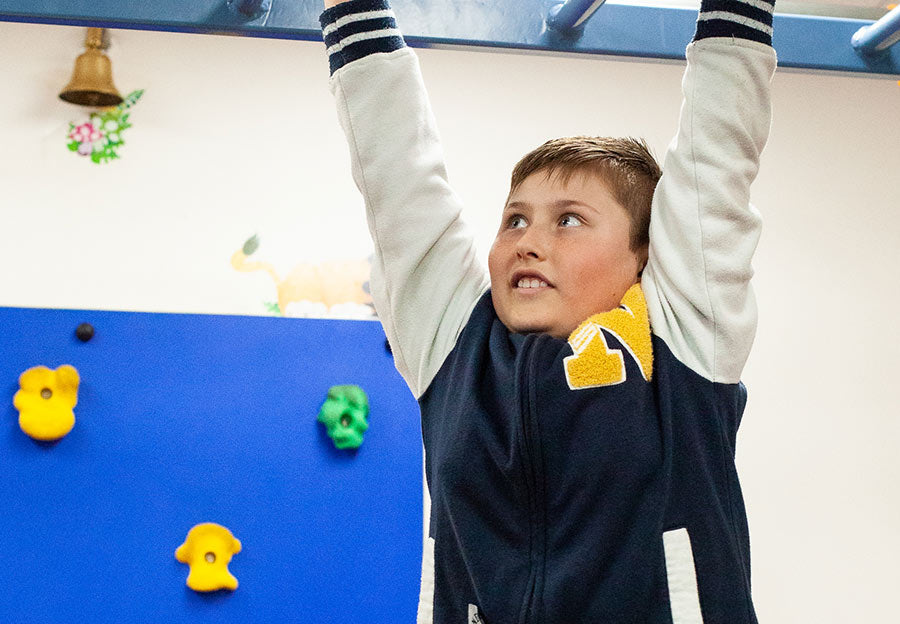
By early elementary, pretend play starts giving way to more structured games with actual rules, and peer-driven social dynamics take over. A playhouse at this age might become the headquarters for a made-up club, complete with membership rules, a password, and strong opinions about who's allowed inside. Cooperative group play is central — kids are now organizing games with friends or siblings rather than just parallel or one-on-one pretend. Physically, this age group is chasing agility and testing physical limits, often wanting to combine the playhouse with climbing, jumping, or connecting it to bigger equipment.
Playhouse must-haves for early elementary kids: A design that connects to, or works alongside, bigger physical equipment like a climbing frame or monkey bars, since pure pretend play is starting to share space with active, physical challenges. Enough durability to handle a more boisterous, physical style of play than a preschooler's. Some sense of "ownership" — a door that locks from the inside, a sign-making spot, a space that feels like genuinely theirs rather than a shared family structure.
Pre-teens (ages 9–12): the hangout and the escape
Traditional pretend play (shopkeepers, dragons, rescue missions) tends to decline sharply by this age, while physical play and social hangout time increase. What kids in this age bracket want most from a playhouse is independence: somewhere to gather with a friend or two, away from adult supervision, that still feels like their own space in the backyard rather than something for "little kids." A playhouse that once hosted elaborate role-play might now just be a low-key spot to sit, talk, and get some distance from the rest of the family for twenty minutes.
Playhouse must-haves for pre-teens: More adult-sized proportions, since younger-kid dimensions start to feel cramped and babyish fast at this age. A more grown-up look and feel — less "cottage," more "cabin" or "hangout" — so it doesn't read as a toy they've outgrown. Enough sturdiness to handle bigger, heavier kids without feeling flimsy, plus flexibility to add features like seating or storage that suit hanging out rather than pretend play.
Buying a future-proof playhouse
The common thread across every stage is this: kids don't just get bigger, they use the same physical space completely differently as they grow. A playhouse that only works for one of these phases is a playhouse you'll be replacing on a schedule.
The better approach is choosing a modular, well-built structure from the start — one that can start small for a toddler and be extended later with a porch, a second story, or a connection to a climbing frame, rather than a fixed design that's frozen at "toddler size" forever. Material matters just as much here as design. A galvanized, powder-coated steel frame holds up to a decade or more of increasingly rough use from an increasingly capable kid, without the rot, splintering, or fading that shortens the life of timber or plastic playhouses well before your child has finished needing one.
Summary
A toddler explores a playhouse with their hands and feet. A preschooler runs a whole imaginary business out of it. A six-year-old turns it into clubhouse HQ. A pre-teen just wants somewhere to sit that isn't the living room. The best playhouse purchase accounts for all four of those kids, not just the one currently living in your house.
Growplay's Playhouse is built with exactly this kind of longevity in mind: a galvanized steel frame with powder-coated aluminum panels, rated for up to four kids at once, designed to grow with your family from toddler exploring to pre-teen hangout. It attaches to the Large or XL monkey bar frame, so if you're starting from scratch, the Large and XL bundles include the frame and playhouse together.